Showing posts with label electronics. Show all posts
Showing posts with label electronics. Show all posts
Thursday, 2 July 2020
Nocturnal Emissions in Dub Volume 2
It's nice of Bandcamp to support this artist by waiving their fees on my birthday! Bandcamp Friday starts at Midnight Pacific Time, which is 8 AM here in the UK and 9 AM Europe Time. Please download! download! download!


Sunday, 20 October 2019
Friday, 6 September 2019
Monday, 26 August 2019
Imber Village & The Delaware Road
So Ian and myself set off from Cornwall on a Saturday morning to Salisbury Plain - bright and early as the A303 is likely to be gridlocked. Traffic was pretty slow, we took the turnoff past the horror that is the Stonehenge Experience,and then...after a while..
along this single track road across the Plain, on roads that are built for tractors and moving troops around.

There’s a lot of vintage red double decker London buses out, and lots of people out for the day. This is the one weekend of the year that the public are allowed into the Imber ghost village.

This village was evacuated in 1943 - and has been used for military training ever since. There’s lots of signs up telling you not to pick up anything that might be an unexploded bomb..well I go for a pee in the bushes behind the car park and find this little unusual metal kind of thing, that looks like it may be some sort of a detonator, er maybe the sort of a thing that a person might pick up and it blows their arm off…so maybe I won’t take that home with. me.


So there’s the village of Imber, presenting very post-Brexit image of rural England, families picnicking by the barbed wire that surrounds the 16th century church, a windowless pubs and farmhouses..the militray industrial complex rooted in the chocolate box rural.
Somehow there’s a bit of a Scarfolk vibe going on --- time has become a loop – and we’re living through a time of power cuts and UFO sightings and cold war paranoia and the BBC Radiophonic Workshop.
So after while, we set off to the New Zealand farm, where this Delaware Road festival is happening in - just back down the track a bit. It's a military training site surrounded by barbed wire & surveillance towers . My bag gets checked over by security --- no they aren’t suppositories, they’re earplugs----
The hidden history of the 20th century....
The camp site is good and has clean enough portaloos. There’s a couple of spent bullet cases where we pitch the tent.

I’m guessing there’s an air of paranoia in the concept behind this festival, but I have to say, in the past I’ve been to some seriously bleak and fairly scary pop festivals, this was in no way one of them.. This one is lovely, there’s a set of concrete buildings, called STONE TENTS, with some spaces as big as a sitting room, some as big as maybe a classroom, and a biggish Nissen hut for the main stage. And most of it is indoors, so there’s very little sound leakage form one venue to another. It’s ideal for left field electronic music and sound and video installations, and that’s what there are here.
A beautiful re-purposing of a space normally used to train people to kill other people. Well, if you don’t think too hard about that, it’s great.
The beer is good and there are number of trajectories I could have taken.. there’s a few faces I recognise: snookering synth superstar Steve Davis is here, the Well Weird West crew from Yeovil have a bunker to themselves, there's people we see on the weirdy music circuit - if there is such a thing..
Theres' something strange set up in the back of a van:

There’s 40 acts in 10 hours, and mostly there’s about three things I want to see on at once.
Best thing is to give up on planning and just wander around....
Here’s some of things I did see:
Alison Cotton – melancholic viola
Cukoo –great synth pop

Penny Rimbaud doing a Q;A about the old days in Crass and then some of his beatnik poetry

A documentary film about Wally Hope (that voice on the phone sounds familiar)
Sarah Angliss gives talk on a man who sold fall out shelters in the 80s and the ridiculous Protect and Survive monthly magazine.
Ian Helliwell – with some sort of tiny video projecting sound to light &;what looks like a battery powered interociter on his desk.
Howlround –– in a room crammed with people and tripped out projections. –

Sequential – a video installation , mesh screen and normal screen with soundtrack left running. Blurry mix of mayday, folk festivals, fires, and flashes of magical symbols and map references and computer code on mesh screen
Kemper Norton – the missing link between Cornish folk and techno youth on mushrooms
Ekoplekz –– I hope somebody recorded what he was doing
Cattle (heavy metal two drummers & very popular here)
Lone Taxidermist – very very loud and playing two human spines
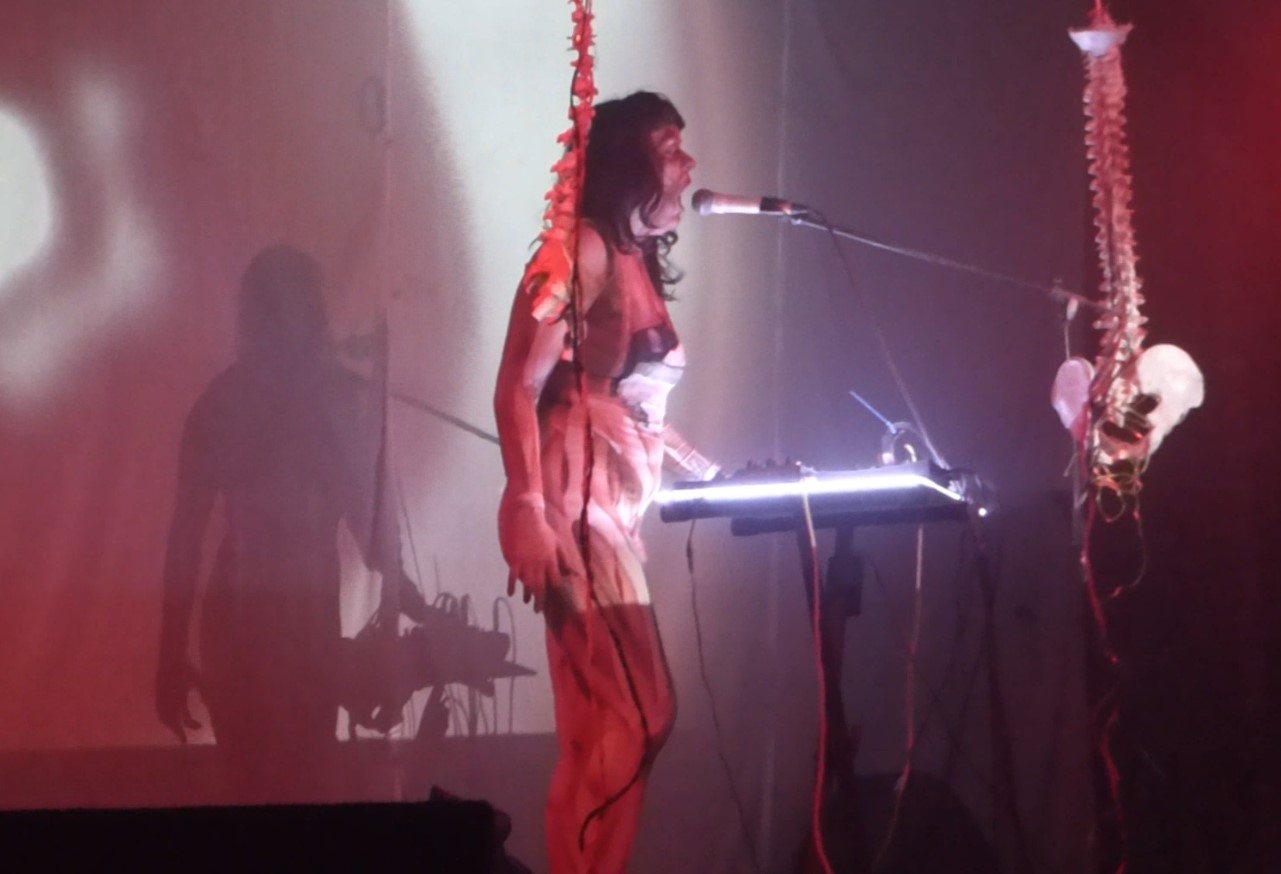
..a siren goes off... a procession with green faced morris men ...
A’Bear -lovely happy uplifting dancey stuff, this fixed my aching back.

it's all a blurr..but..
An amazing bit of organisation by https://buriedtreasure.bandcamp.com/.
All in all a brilliant weekend!
Saturday, 15 August 2015
Synthesiser And NEo-Tantric Oscillating Nostrum
The S.A.N.T.O.N.
· Lulls you into an untroubled frame of mind
· Helps clear the head
· Comforts and soothes after a stressful day
Whether you’re panicking about an interview, dreading a visit to the dentist, of distracted by family problems, everyone reacts to stressful events in their life.
The S.A.N.T.O.N. is intended to mimic the effect of your illness, so encouraging the body into greater defense efforts.
Sometimes at the start of treatment you may find your symptoms actually get slightly worse. This is common and it’s a sign that your body’s starting to heal itself. However, if symptoms persist you should consult your GP. T
These therapeutic sounds were recorded by direct line input on 15 August 2015 in a haven of peace and tranquility close by the A390 in Lostwithiel, Cornwall.
Wednesday, 5 August 2015
Desiring machine - work in progress
Desiring- machines "work only when they break down, and by continually breaking down"
Sunday, 26 July 2015
Tuesday, 21 April 2015
Monday, 1 August 2011

Friday, 1 April 2011
Mantrachanter
An electronic device specially built to chant the first words of Space Cornish.
Work in progress.
Sunday, 14 November 2010
Sunday, 19 September 2010
The Desiring Machines
Emanation Machine
V1.01 responds to the emotional arousal of the user, as well as to environmental factors, providing an interface with residual energies in the etheric field. The device utilises a powerful 9 x 9 UV matrix, pedagogic voice enchanter and electro-mechanical counter. The potentiser contains a 30C homeopathic potency of Nux Vomica, pre-eminently the remedy for many of the conditions incident to modern life.
Etheric Link Machine
Contains electro-magnetic hand scanner, multiple etheric sensors and homeopathic potentiser, linked to a morphic resonator. In the hands of a trained operator, the Etheric Link Machine is an effective diagnostic and therapeutic instrument, its efficacy reliant on the ESP level of the user.
Intensity Production Machine
Contains Zenor activation buttons, multiple etheric sensors, electronic voice phenomenomiser and homeopathic potentiser. The Intensity Production Machine is good for you. It has ethical content. It illuminates the human condition. It reveals deep inner truths that cannot be expressed in words.
Sunday, 12 April 2009
Exterminator
Exterminator is an electronic sound object made by Nigel Ayers, it contains a three step sequencer which activates a sound chip found in a Dr Who Dalek Easter Egg.
The Daleks were created by writer Terry Nation and designed by BBC designer Raymond Cusick. They were introduced in December 1963 in the second Doctor Who serial.They became an immediate hit with viewers, featuring in many subsequent serials and two 1960s motion pictures. They have become synonymous with Doctor Who, and their behaviour and catchphrases are part of British popular culture. "Hiding behind the sofa whenever the Daleks appear" has been cited as an essential element of British cultural identity, and in a 2008 survey, 9 out of 10 British children were able to identify a Dalek correctly.
The word "Dalek" has entered the Oxford English Dictionary and other major dictionaries; the Collins Dictionary defines it rather broadly as "any of a set of fictional robot-like creations that are aggressive, mobile, and produce rasping staccato speech". Terry Nation once said in an interview he got the idea for the name from the spine of an enyclopaedia, the volume covered DAL-LEK, although no such book has ever been found and Nation later admitted he had made this story up. It is also a trademark, having first been registered by the BBC in 1964 to protect its lucrative range of Dalek merchandise.
The term is sometimes used metaphorically to describe people, usually figures of authority, who act like robots unable to break from their programming. John Birt, the Director-General of the BBC from 1992 to 2000, was publicly called a "croak-voiced Dalek" by playwright Dennis Potter in the MacTaggart Lecture at the 1993 Edinburgh Television Festival.
The staccato delivery, harsh tone and rising inflection of the Dalek voice were initially developed by voice actors Peter Hawkins and David Graham, who would vary the pitch and speed of the lines according to the emotion needed. Their voices were further processed electronically by Brian Hodgson at the BBC Radiophonic Workshop. Although the exact sound-processing devices used have varied, the original 1963 effect used EQ to boost the mid-range of the actor's voice, then subjected it to ring modulation with a 30 Hz sine wave. The distinctive harsh grating vocal timbre this produced has remained the pattern for all Dalek voices since (with the exception of those in the 1985 serial Revelation of the Daleks, for which director Graeme Harper deliberately used less distortion).
Since 2005, the Dalek voice in the television series has been provided by Nicholas Briggs, speaking into a microphone connected to a voice modulator.In a 2006 BBC Radio interview, Briggs said that when the BBC asked him to do the voice for the new television series, they instructed him to bring his own analogue ring modulator that he had used in the audio plays. The BBC's sound department had changed to a digital platform and could not adequately create the distinctive Dalek sound with their modern equipment. Briggs went as far as to bring the voice modulator to the actor's readings of the scripts. He has used his modulator also for voicing the Cybermen in the 2006 series.
Easter eggs are specially decorated eggs given to celebrate the Easter holiday or springtime.
The egg was a symbol of the rebirth of the earth in Pagan celebrations of spring and was adopted by early Christians as a symbol of the rebirth.
The oldest tradition is to use dyed or painted chicken eggs, but a modern custom is to substitute chocolate eggs, or plastic eggs filled with confectionery such as jelly beans. These eggs are often hidden, allegedly by the Easter Bunny, for children to find on Easter morning. Otherwise, they are generally put in a basket filled with real or artificial straw to resemble a bird's nest.
The egg is widely used as a symbol of the start of new life, just as new life emerges from an egg when the chick hatches out.
The ancient Persians painted eggs for Nowrooz, their New Year celebration, which falls on the Spring equinox. The Nawrooz tradition has existed for at least 2,500 years. The decorated eggs are one of the core items to be placed on the Haft Seen, the Persian New Year display. The sculptures on the walls of Persepolis show people carrying eggs for Nowrooz to the king.
At the Jewish Passover Seder, a hard-boiled egg dipped in salt water symbolizes the festival sacrifice offered at the Temple in Jerusalem.
The pre-Christian Saxons had a spring goddess called Eostre, whose feast was held on the Vernal Equinox, around 21 March. Her animal was the spring hare. Some believe that Ēostre was associated with eggs and hares, and the rebirth of the land in spring was symbolised by the egg. Ēostre is known from the writings of Bede Venerabilis, a seventh-century Benedictine monk. Bede describes the pagan worship of Ēostre among the Anglo-Saxons as having died out before he wrote about it. Bede's De temporum ratione attributes her name to the festival, but does not mention eggs at all.
Other theories such as Jakob Grimm’s in the 18th Century believe in a pagan connection to Easter eggs via a putatively Germanic goddess called Ostara.
The English name for the festival of Easter derives from the Germanic word Eostre. It is only in Germanic languages that a derivation of Eostre marks the holiday. Most European languages use a term derived from the Hebrew pasch meaning Passover. In Spanish, for example, it is Pascua; in French, Pâques; in Dutch, Pasen; in Greek, Russian and the languages of most Eastern Orthodox countries: Pascha. In Middle English, the word was pasche, which is preserved in modern dialect words. Some languages use a term meaning Resurrection, such as Serbian Uskrs.
Pope Gregory the Great ordered his missionaries to use old religious sites and festivals, and absorb them into Christian rituals where possible. The Christian celebration of the Resurrection of Christ was ideally suited to be merged with the Pagan feast of Eostre, and many of the traditions were adopted into the Christian festivities.
A virtual Easter egg is an intentional hidden message, in-joke or feature in an object such as a movie, book, CD, DVD, computer program, web page or video game. The term draws a parallel with the custom of the Easter egg hunt observed in many Western nations, but actually is derived by the practice of the last Russian imperial family's tradition of giving elaborately jeweled egg-shaped creations by Fabergé which usually contained hidden gifts themselves.
This practice is similar in some respects to hidden signature motifs such as Diego Rivera including himself in his murals, Alfred Hitchcock's legendary cameo appearances, and various "Hidden Mickeys" that can be found throughout Disneyland. An early example of these kind of "Easter eggs" is Al Hirschfeld's "Nina".
Exterminator! is a short story collection written by William S. Burroughs and first published in 1973 (some editions such as the 1974 paperback illustrated at right label the book a novel)."The Exterminator is another collection of stories Burroughs published in 1960 in collaboration with Brion Gysin. The titles refer to a job as in insect exterminator that Burroughs himself once held. Certain aspects of this story were used in the film version of Naked Lunch, with the main character William Lee (a portrayal of Burroughs) holding the same job at the film's beginning.
In the summer 2009 Exterminator will be played live as part of BZZZOING! Future Sounds & Music By Mail by the BAU Artkestra in a public performance in Viareggio, Italy and documented in the magazine Arte Postale! 100. Vittore Baroni writes: "2009 marks 100 years from the first Manifesto of Futurism. In 2009 will be published the 100th issue of Arte Postale!, a mail art magazine that I started thirty years ago, in October 1979. What puts in relation the two events is sound: Futurist Luigi Russolo’s Manifesto The Art of Noise is a milestone in the history of the experimental and weird sounds that I have been promoting since the early Seventies in my journalistic work for a long string of publications (Rockerilla, Velvet, Vinile, Urlo, Sonora, Underground, Rumore, etc.). Music was also the theme of the first three issues of Arte Postale!, so I return to the subject in this open invite to the hundredth issue."
Monday, 26 January 2009
ideal husband ideal wife
Mr and Mrs Ayers demonstrate how a simple electronic device can enhance marital bliss.
Subscribe to:
Posts (Atom)