Showing posts with label film. Show all posts

Sunday, 4 February 2024

Charlotte Bill and the Nocturnal Emissions


Northern English artist Charlotte Bill can be credited for her contribution to the unique acoustic character of Nocturnal Emissions’ work in the early to mid 1990s. Her improvisations on flute, oboe and other instruments were “decomposed”, remixed and reprocessed by Nigel Ayers notably on the CD releases: Magnetized Light, Blasphemous Rumours, Friction & Dirt and Binary Tribe.
 

Charlotte created film projections for Nocturnal Emissions live performances in Canada and has made several animated and experimental films soundtracked by, and sometimes in collaboration with, Nocturnal Emissions founder, Nigel Ayers. In the past Charlotte has also played in The Fall , The Fates, The Blue Orchids, Morning Glory and the Shillelagh Sisters.  


Charlotte first performed with Nocturnal Emissions as a fire-blower in unforgettable shows in the Ambulance Station and the ICA, London in 1984/1985. She is nowadays better known for her art films, TV documentaries and as founder member of filmmaking collective Clapham Film Unit. ](https://charlottebill.com/) 

https://www.imdb.com/name/nm8915449/


 Charlotte will be making a live guest appearance with Nocturnal Emissions in the Farmers Arms, Penzance, March 2nd 2024.


Sunday, 22 September 2019

21st Century Spirit Photography


Nature spirit photographs revealed through digital scanning and processing of acrylic painted 16mm cine film. The sequence represents a vortex effect,  a portal through which Faerieland can be reached. Strangely, turning the screen upside down reveals a similar image.

Wednesday, 12 June 2019

It's Just like Real Life

Music by Ubiquitous Meh!
Film by Nigel Ayers


I read in the bible where Cain killed Abel
it's just like real life
That bit in Friends where Ross says Pivot
it's just like real life
That bit in my dreams where I thought could speak to you
It's not like real life
That bit in my nightmare where I saw you with Barry
it's just like real life

Have you heard that song by Ubiquitous Meh
it's just like real life
Have you seen that advert With that perfect fucking family
it's just like real life
That bit in my dreams, I was sure I could speak to you
that's not like real life
That bit in my nightmare where I saw you with perfect fucking Barry
it's just like real life

https://ubiquitousmeh.bandcamp.com/

Tuesday, 25 June 2013

Live shows coming up

Nigel Ayers will be performing at

Penryn Arts Festival
Friday 26th July 8.00
The Ark, Jubilee Wharf
Penryn, Cornwall

http://www.penrynartsfestival.co.uk/#!nigel-ayers/c1lvu 

and

 The Fascinate Showcase :
Wednesday 28 August, 2013
The Performance Centre,
Falmouth University,
Tremough Campus,
Cornwall.

 http://www.fascinateconference.com/showcase/

Monday, 24 September 2012

Slime Trails


Nigel Ayers’ "Slime Trails" records two terrestrial gastropods, active just after rain. The camera casts a relentlessly flawed eye over the scene, which is so botched, off-centre and fragmented that subjects the gastropods to its unblinking stare, leaving them stripped bare on more levels than mere physical nudity and without a full-sized shell. Slugs produce two types of mucus: one which is thin and watery, and another which is thick and sticky, adding a whole new tactile dimension to the camera’s way of looking. Beyond the bodies made up mostly of water, the scene is so relentless and obstinate that the slime trail is turned back on the viewer, who thus becomes the decomposer, chewing up leaves, feces, and other detritus and helping to recycle the nutrients back into the soil. Examining the relationship between ecosystem services and biodiversity as a formal surrogacy relationship facilitates a more analytical examination and brings the issues into sharper relief. The slugs subtly deconstruct the conventional system of the male gaze in conditions and processes, through self-portrayal and seduction strategies which sustain and replenish soil fertility.

Thursday, 16 December 2010

The Lion of Goonzion - Landscape Giant embedded in Google Map


Nested Signs in nested landscapes.

Many sightings of the Beast of Bodmin Moor say that it is lion-like, this could be a thought form emanation from the Leo Zodiac outline, which in turn may indicate the boundaries of a Mesolithic (and later Celtic) tribal area.

Leo’s body lies over Goonzion Downs, he is the Lion of Goonzion. Leo also stands on the village of Ley, it could be said that he is a “Ley lion”. Another place name that makes up his outline is Luna. Luna is the Latin name of the Earth's Moon as well as the Roman moon goddess Luna. Leo also stands over the 1412 Pant(h)ers Bridge.


This is such a dense and potentially dangerous system that attempts to give a workable summary of it would achieve nothing worthwhile.. see the book THE BODMIN MOOR ZODIAC by Nigel Ayers (2007).

http://maps.google.co.uk/maps?ll=50.487166,-4.576836&spn=0.038773,0.077162&t=h&z=14&iwloc=lyrftr:com.youtube.all,6572553384516215121,50.482197,-4.595718&lci=com.youtube.all

Wednesday, 15 December 2010

Nigel Ayers "Spoon" (1970)


This is the first film I made. It's shot on Standard 8mm film stock in Tideswell, Derbyshire, 1970. I'd be 13 years old. The cast includes myself, John Allen, Danny Ayers, Mary Ayers and Nick Buttle. The original footage is silent. The soundtrack here is from Nocturnal Emissions "Duty Experiment" CD, recorded a decade later.

Tuesday, 11 May 2010

Monday, 10 May 2010

The films of Alejandro Jodorowsky


Alejandro Jodorowsky was active as a film director in the 60s and 70s, following a career as an actor and director of experimental theatre and happenings.

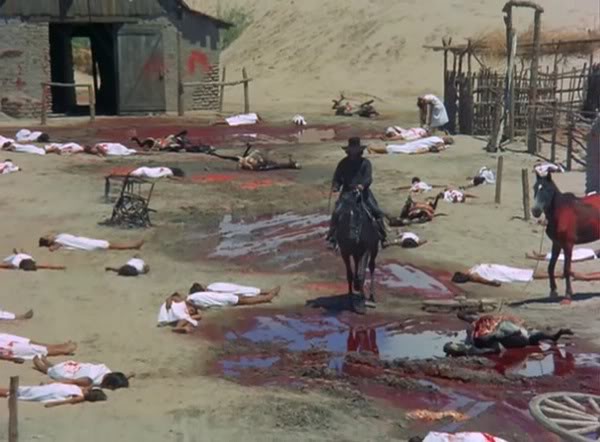
Jodorowsky’s 1970 film El Topo was a surreal blend of the Wild West and eastern philosophy. Sort of Luis Bunuel meets Sergio Leone with a touch of Kenneth Anger and performance art thrown in: nudity, amputees, dead animals, lots of blood, spiritual philosophy and psychedelia. It was packaged and promoted as “midnight movie cult cinema” in the Elgin Cinema, New York, relying on word-of-mouth recommendation among Chelsea hipsters. And so, they say, it helped establish an “outsider” genre of films based on a culture of late-night screenings, reviving interest in neglected filmmakers like Tod Browning and Ed Wood, and providing an audience for new film makers like David Lynch and John Waters. Critic Ben Cobb writes that after enthusiastic recommendation by John Lennon , “El Topo screenings took the form of a drug-fuelled happening. People went to be mentally altered by the film, spiritually enriched or, at the very least, have an experience.”

John Lennon’s manager Allen Klein saw potential in Jodorowksy’s brand of druggy-exploitation cinema, bought the rights to El Topo and put the money up for his next film The Holy Mountain (picture below). Klein screened El Topo in a Broadway cinema, which immediately blew its credibility as far as its cultish audience was concerned. Having learned a marketing lesson, screenings of The Holy Mountain were limited to midnight slots on Fridays and Saturdays where they attracted a sizeable cult following for a remarkable 16 months.


Jodorowsky and Klein fell out over a new exploitation film project they were discussing. According to Jodorowsky “I weighed up my artistic integrity against fame and wealth. After a torturous half-hour, I reached my decision.” Allan Klein was furious and did his best to make sure that El Topo and The Holy Mountain were never screened, while Jodorowsky did his best to encourage the spread of bootlegs of the two films. There were legal battles until 2004 when some sort of reconciliation was reached and the films are now widely available on DVD.

Jodorowsky went on to make the exploitation film “Santa Sangre”, but seems to have been mostly occupied with a writing career, books on psychology and the tarot as well as the sort of adult graphic novels that are popular in France.

Jodorosky’s films El Topo and The Holy Mountain contain some of the most striking and strange sequences in modern cinema. They are masterpieces of grandiose self-indulgence, and have been a big influence on the likes of Matthew Barney. Their bizarre scenes and ritualized narrative structures are the sort of thing you grow accustomed to if you’re familiar with avant-garde and outsider art, but never with this kind of budget.

What is puzzling, then, is how these films ever got made. The extras on Jodorowsky's DVD collections show him at work doing tarot readings and conducting seminars on “Psychomagic: The Transformative Power of Shamanic Psychotherapy” (the title of his latest book). What becomes clear is that the guy is very persuasive and has great manipulative skills. The people with the money must have been suckers for that kind of scam back in the day...

Alejandro Jodorowsky's 'Dune: An Exhibition of a Film of a Book That Never Was was at Plymouth Arts Centre 2 April – 16 May 2010. Curated by Tom Morton. See review by Nigel Ayers.

for art cornwall

http://www.artcornwall.org/features/Films_of_Jodorowsky.htm

Alejandro Jodorowsky's 'Dune: An exhibition of a film of a book that never was

Alejandro Jodorowsky's 'Dune: An exhibition of a film of a book that never was

Plymouth Arts Centre 2 April – 16 May 2010


Dune is a weighty Science Fiction novel written by Frank Herbert and published in 1965. The cover blurb by Arthur C. Clarke says its “unique among SF novels. I know nothing comparable to it except The Lord of the Rings”.

There have been several attempts made to film the book, and the rights to it have passed through several hands. It has been the subject of a TV mini-series, and a new cinema version is currently being planned, to be directed by action specialist Pierre Morel.

1984 saw David Lynch's version of the book. Lynch's Dune was not well-received by critics and performed poorly at the American box office. Lynch distanced himself from the project, stating that pressure from both producers and financiers restrained his artistic control and denied him final cut privilege.

In some versions of the film Lynch's name is replaced in the credits with the name of a fictional director Alan Smithee: a pseudonym used by directors who wish to be disassociated from films they have worked on. In fact, like a lot of bad sci-fi, David Lynch’s Dune retains a fairly large cult following.

Before Lynch, in 1976, Alejandro Jodorowsky was given the job of directing the film. He gathered around him a group of collaborators including the Swiss artist HR Giger, who later designed the movie Alien, the French graphic novel artist Moebius, and English sci-fi artist Chris Foss. Pink Floyd were to provide the soundtrack and the proposed cast was to feature Orson Welles, Mick Jagger, David Carradine and Salvador Dali. Dali was to play the Emperor of the Universe who ruled from a golden toilet-cum-throne in the shape of two intertwined dophins, their mouths designed to receive, respectively, urine and excrement: “Dali considers it very bad taste to mix piss and shit”.

But Jodorowsky never got the finance and the project was abandoned. All that survives are the director's notes and production drawings by Giger, Moebius and Foss.

Jodorowksy has written about his adventures in film-making as a process of spiritual discovery and has said film-making should be a way of losing money, not making it. “Contemporary art” tends to be all about about price tags and status, so I was interested to see the interpretation of this material by the contemporary artists in this touring show. I hoped for something over-the-top and mystically bonkers.

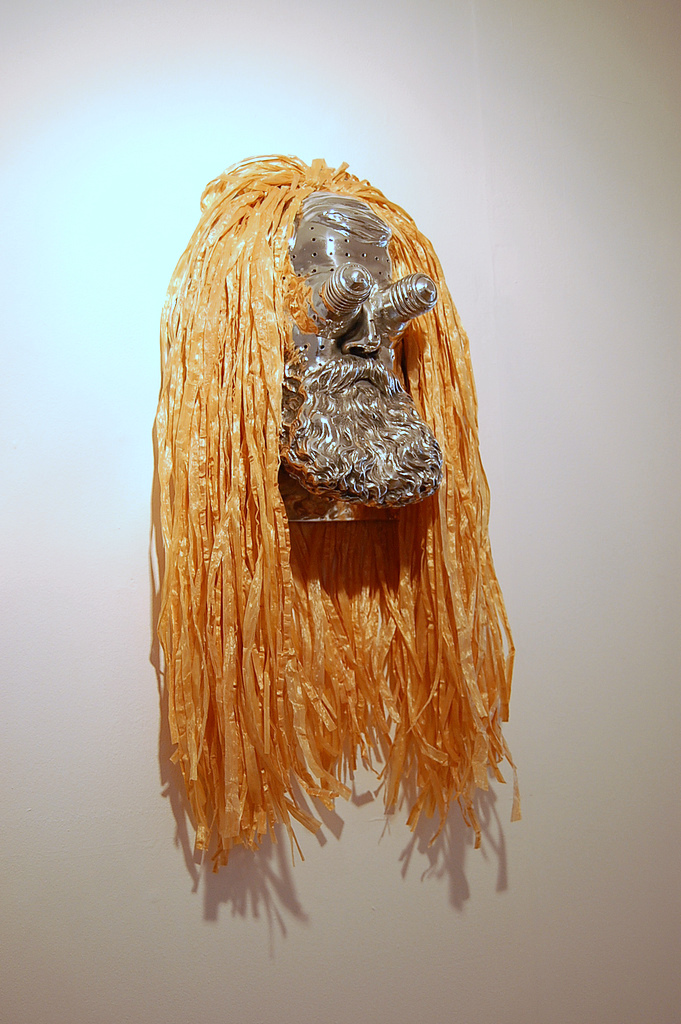
In the downstairs room there’s a chrome head with raffia hair and bulging eyeballs. This is a Steven Claydon piece. The chromed metal looks like it may have once been a colander and yes, it could easily be a portrait of the young Jodorowsky strung out on amphetamine...

On the opposite wall is a portrait print also by Claydon. It’s not Jodorowsky. Perhaps this is a portrait of Frank Herbert? I look at the label and find it’s a portrait of Somerset Maugham. I wonder what Somerset Maugham has got to do with the film that never was? Tom Morton's notes say it may “be read as a stand-in for the Emperor Shadam IV (Maugham’s stately pleasure dome Villa Mauresque recalls the Emperor’s golden planet)”. So, it’s not Emperor Shadam IV, it’s not the Emperor’s golden planet, it’s a portrait of an author who once wrote a book with a scene in it that was similar to a scene in Dune. So this is the Portrait of the Author of a Book That Contains a Scene In It That is Similar to a Scene in The Book...

Vidya Gastaldon's paintings are small, pleasant watercolours with pieces of Herbert's text written on them. They're a bit like William Blake's in style, only William Blake put a bit more effort in. Blake would have also used his own secret method of printing and his own text, whereas Gastaldon 'has used Herbert's novel as an i-Ching-like instrument of divination, flicking through the pages at random and then making an image based on the first line her eyes alight on'. So she hasn't actually read Dune, she's just skimmed though it a bit? I love the way contemporary artists cut corners!

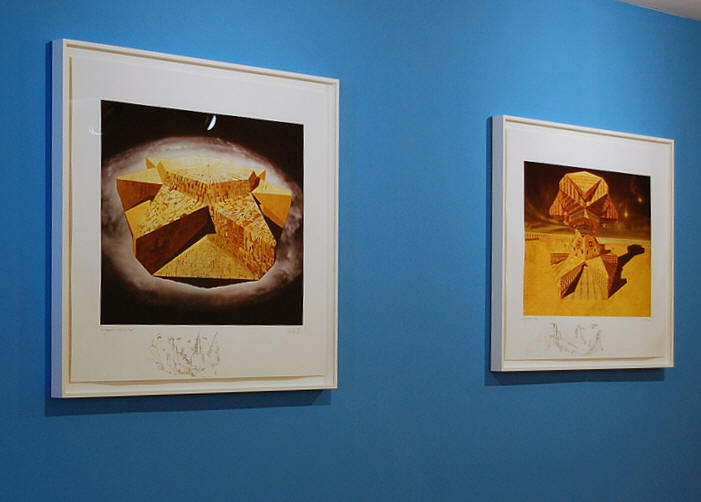
Upstairs there are materials actually related to Jodorowsky's Dune project: a set of nice big illustrations by both Giger and Foss and loads of magazine clippings about the project.

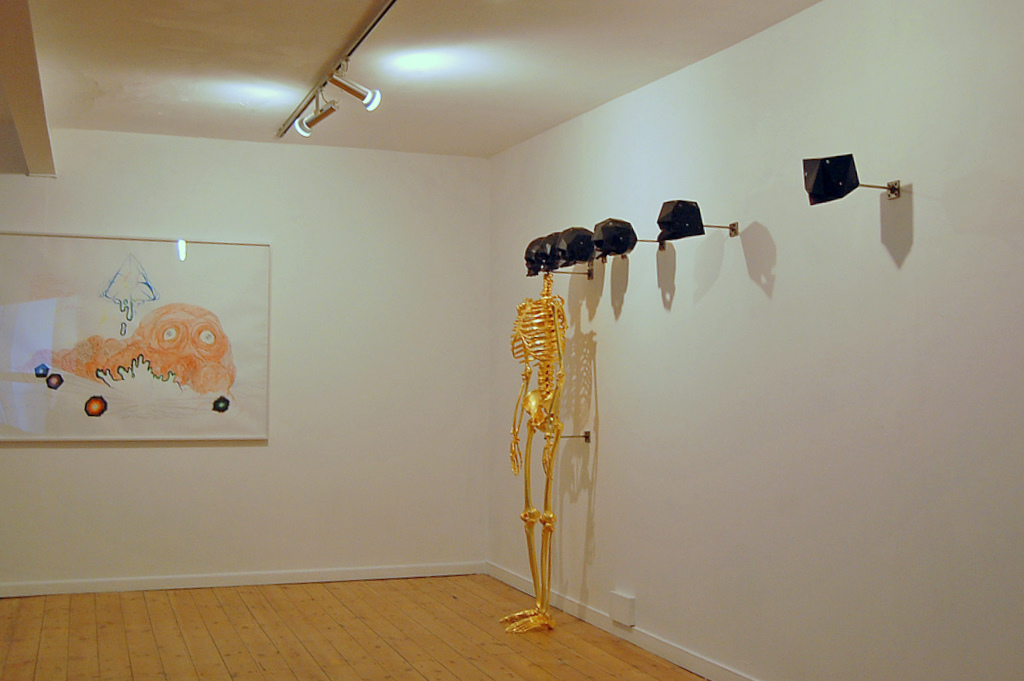
On the top floor, in the exhibition space, there's Day Jackson's piece. His human skull morphing into platonic solids seems to be in a Jodorowsky groove, and there's a load of science fiction comics on loan from a local shop, and some reading matter on the subject of science fiction illustration.

Curator Tom Morton writes that the remains of Jodorowksy's Dune project: “reveal a potential future for sci-fi movie making that eschewed the conservative, technology-based approach of American filmmakers in favour of something closer to a metaphysical fever-dream...In 1977, George Lucas' Star Wars was released and the history of sci-fi filmmaking and even mainstream cinema, would never be the same again

I'm not so sure that the sci-fi movie genre and mainstream cinema has become so much technology-based as effects-based in its approach, and that beneath this layer of sensationalism its underlying ethos is to re-inforce the fears and insecurities that drive the modern hyper-capitalist economies. There seems instead in Jodorowsky's sacrificial film-making an attempt to blow apart those insecurities and enter into something akin to personal freedom and autonomy, using film as an uninhibited process of spiritual discovery, rather than a means to make money for corporations.

But then the guy is so obviously barmy that it's hard to tell.


Nigel Ayers 27/4/10

photos by Lesley Ayers

for http://www.artcornwall.org/

Thursday, 13 August 2009

Butterfly (1973)


As you can see from the shots of a black & white TV, this was made in pre-digital times. I made the movie around 1973, when I was 16 years old.
Shot on a clockwork Standard 8mm movie film camera. Standard 8 was a home movie format that preceded Super 8mm. It's like Super 8 but it has larger sprocket holes. The format used 16mm film stock, which needed to be turned over halfway through shooting to expose the other side of film. When processed the film was split down the middle then joined up again to form a continuous 8mm film. This meant it was easy to generate randomised mulitple expoures, by putting the film through the camera several times. So all the edits and superimpositions you see were done in the camera.
The soundtrack is a new addition, a remix of some prog rock from that era.

Saturday, 31 January 2009

Jeff Keen


A few months ago, I had some time on my hands and I was thinking about films. I was thinking isn't it good that something like Youtube exists and there's really easily accessible digital editing and there's ways of making and using film in a personal way that didn't exist before. And that it's really good that this has come about because for so long the idea of FILM has been dominated by Hollywood with big budgets, freakishly photogenic actors, commercial gloss.

I was thinking about the films I really liked (the names Jan Svankmajer, Terry Gilliam, Jodorowsky came up) and I remembered Jeff Keen. Back in the early 80s I'd videotaped a 3 minute film of his that was shown at about one in the morning in a Channel 4 or BBC series on experimental cinema. It was a genuinely hand made film, a mad collage of flashy splashy paint and gestural pop art images and text that went BLATZ!. A while later I went along to a screening of his film at the London Filmmaker's Co-Op. Jeff Keen was there in the flesh and introduced the film by setting fire to an Action Man. There was another film in which he and his actor friends were there in the flesh doing some sort of live performance which overlapped the 24 frames per second action.


I never heard anything about Jeff Keen or his films since. So about six months ago I looked him up online and found a web site -in - process with a few press cuttings on it from but nothing to be found on Youtube (though there is now, see below) but there was the promise of a DVD release. And then a couple of weeks ago I find out that Stewart Home is to be one of the presenters of major retrospective of Keen's films at the BFI at the end of February and what's more they're releasing over 9 hours of films and videos by Jeff Keen on Blu-ray and DVD and there'll be screening around the UK. I can't wait.

In the meantime I sent off for Prisoner of Art, a DVD in a handmade collage booklet from the man himself. It's wicked.


Born in 1923, Keen is still actively creating films, artworks and experimental soundtracks. Fiercely independent and working for the most part outside of the mainstream and avant-garde circuits, Keens prolific output has embraced collage, live action, diary film and animation - often played out as expanded cinema performances where chance and accident are vital components. In 2009 the British Film Institute will tour and release a Blu-Ray retrospective of Jeff Keens work. Available Jan 2009 is 'Prisoner of Art' a limited edition self released book of collages and artworks that includes a DVD-R of shorts and new soundtracks. www.kinoblatz.com.

Thursday, 7 February 2008

Super 8 footage unearthed


This flickery video is what you might call a "rush" based on some small assemblages I made in 1989. The original footage was shot on Super 8, (this lends organic saturated colours and texture, etc ). I put it through After Effects and some other digital programs this week. I intend to do some more work on this film later - but with it being 18 years in the making, I thought it might be nice to show it in its present state.