

Photos by Rupert White http://artcornwall.org/exhibitions/Inland2016pt3.htm
See also: http://nigelayers.com/pages/spacecornish.html
and http://www.lulu.com/shop/nigel-ayers/a-dictionary-of-space-cornish/paperback/product-1540240.html


Alejandro Jodorowsky's 'Dune: An exhibition of a film of a book that never was
Plymouth Arts Centre 2 April – 16 May 2010
There have been several attempts made to film the book, and the rights to it have passed through several hands. It has been the subject of a TV mini-series, and a new cinema version is currently being planned, to be directed by action specialist Pierre Morel.
1984 saw David Lynch's version of the book. Lynch's Dune was not well-received by critics and performed poorly at the American box office. Lynch distanced himself from the project, stating that pressure from both producers and financiers restrained his artistic control and denied him final cut privilege.
In some versions of the film Lynch's name is replaced in the credits with the name of a fictional director Alan Smithee: a pseudonym used by directors who wish to be disassociated from films they have worked on. In fact, like a lot of bad sci-fi, David Lynch’s Dune retains a fairly large cult following.
Before Lynch, in 1976, Alejandro Jodorowsky was given the job of directing the film. He gathered around him a group of collaborators including the Swiss artist HR Giger, who later designed the movie Alien, the French graphic novel artist Moebius, and English sci-fi artist Chris Foss. Pink Floyd were to provide the soundtrack and the proposed cast was to feature Orson Welles, Mick Jagger, David Carradine and Salvador Dali. Dali was to play the Emperor of the Universe who ruled from a golden toilet-cum-throne in the shape of two intertwined dophins, their mouths designed to receive, respectively, urine and excrement: “Dali considers it very bad taste to mix piss and shit”.
But Jodorowsky never got the finance and the project was abandoned. All that survives are the director's notes and production drawings by Giger, Moebius and Foss.
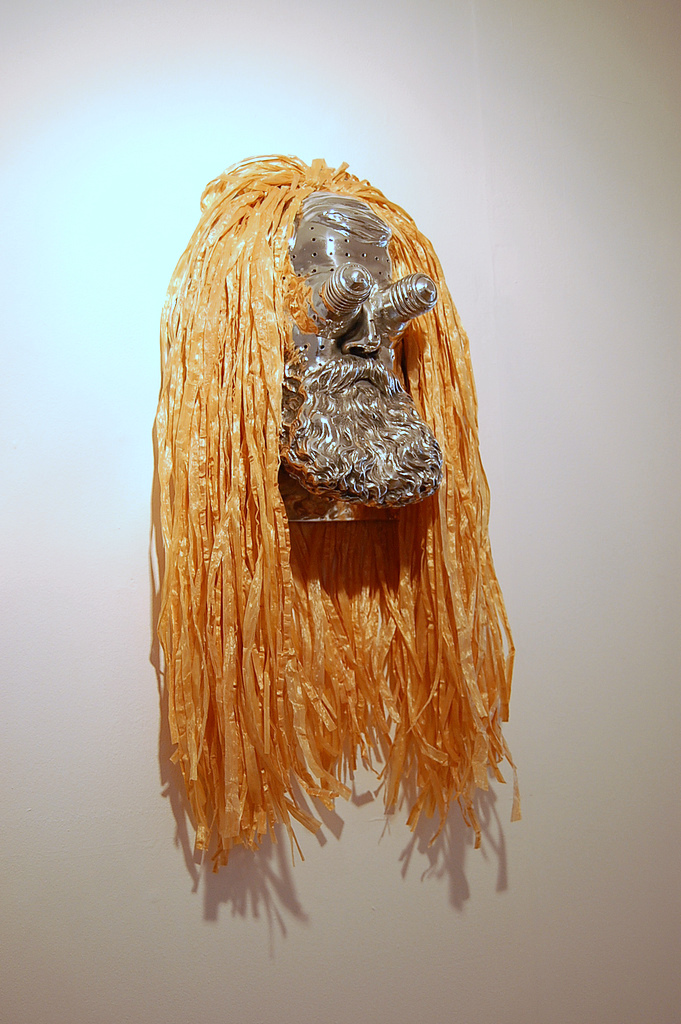
In the downstairs room there’s a chrome head with raffia hair and bulging eyeballs. This is a Steven Claydon piece. The chromed metal looks like it may have once been a colander and yes, it could easily be a portrait of the young Jodorowsky strung out on amphetamine...
On the opposite wall is a portrait print also by Claydon. It’s not Jodorowsky. Perhaps this is a portrait of Frank Herbert? I look at the label and find it’s a portrait of Somerset Maugham. I wonder what Somerset Maugham has got to do with the film that never was? Tom Morton's notes say it may “be read as a stand-in for the Emperor Shadam IV (Maugham’s stately pleasure dome Villa Mauresque recalls the Emperor’s golden planet)”. So, it’s not Emperor Shadam IV, it’s not the Emperor’s golden planet, it’s a portrait of an author who once wrote a book with a scene in it that was similar to a scene in Dune. So this is the Portrait of the Author of a Book That Contains a Scene In It That is Similar to a Scene in The Book...

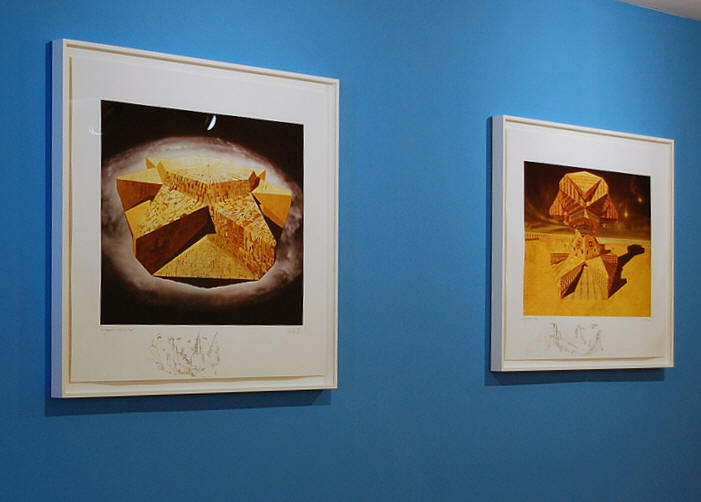
Upstairs there are materials actually related to Jodorowsky's Dune project: a set of nice big illustrations by both Giger and Foss and loads of magazine clippings about the project.
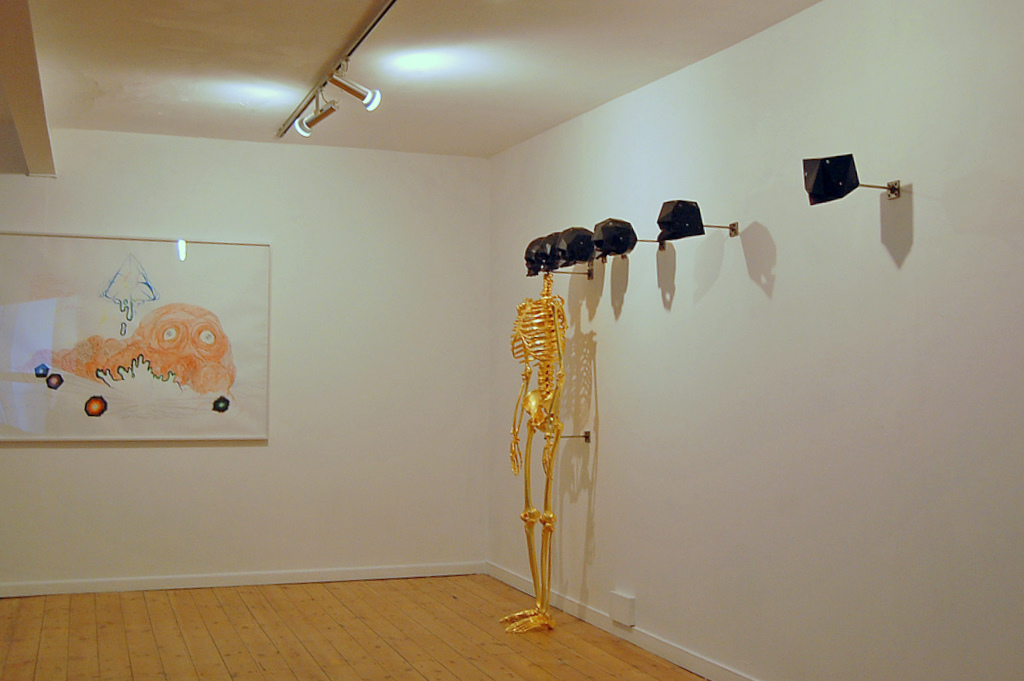
On the top floor, in the exhibition space, there's Day Jackson's piece. His human skull morphing into platonic solids seems to be in a Jodorowsky groove, and there's a load of science fiction comics on loan from a local shop, and some reading matter on the subject of science fiction illustration.
I'm not so sure that the sci-fi movie genre and mainstream cinema has become so much technology-based as effects-based in its approach, and that beneath this layer of sensationalism its underlying ethos is to re-inforce the fears and insecurities that drive the modern hyper-capitalist economies. There seems instead in Jodorowsky's sacrificial film-making an attempt to blow apart those insecurities and enter into something akin to personal freedom and autonomy, using film as an uninhibited process of spiritual discovery, rather than a means to make money for corporations.
But then the guy is so obviously barmy that it's hard to tell.
Nigel Ayers 27/4/10
photos by Lesley Ayers
As we arrived outside the
Banksy crossed from subculture to mainstream a few years back, following his move from Bristol to the art capitals of the world, a bestselling coffee-table art book, and his work getting regular exposure on TV and in the international press. Not to mention the phenomenally high prices being paid for his paintings at auction. So this is the local boy giving something back to the hometown that still bears the marks of his early stencil-work. The flyer says “PG Contains scenes of a childish nature some adults may find disappointing”.
The queue turned out to be for one and a half hours. I usually avoid events you have to queue for, but it was a nice sunny day and we were treated to the occasional sight of middle aged women joggers dressed in pink bras puffing and panting their way up the hill in support of a breast cancer charity. Also I found the queue added to the theatre of the occasion, and as you got closer to the entrance of the museum, the excitement seemed to build with the first whiffs of aerosol paint.

The artist has chosen to hire this museum and cover all the expenses for what must be his first major show in this country. And admission is free. And there’s no Banksy merchandising at the museum, apart from the book “Wall and Piece” (which you find all over Bristol anyway) though the Oxfam shop across the road is doing a nice line in Banksy stickers and postcards.
So, we found ourselves being corralled into this old stuffy museum and being greeted by friendly museum 
At the entrance, there’s a
As you shuffle down the corridor, there’s a candlelit shrine in homage to the recently deceased pop star, Michael Jackson (below). It’s an oil painting in Victorian genre style of a fairytale cottage in dark woods, with The King of Pop as the wicked witch Jacko leaning out of the doorway offering candy sticks to tempt two lost children inside.
Once you’ve got through all this entrance malarkey, you’re free to wander round the displays, and the museum is large and not so crowded once you get inside. And you’re allowed to take photographs.
The first room is exclusively Art of Banksy, with a militant looking false ceiling of army-surplus camouflage net. And behind a screen of chicken wire you can see a full-scale mock-up of the artist’s studio, hung with loads of cardboard stencils, newspaper headlines about Banksy’s graffiti, filing cabinets are labelled “good ideas” “bad ideas” “other people’s ideas” and “porn”, a knitted cardigan that reads THUG FOR LIFE hangs off the artist’s chair. There’s the sound of a London radio phone-in on some Banksy controversy or other. On the easel is an oil painting of pixellated-faced portrait of a hoody in a baseball cap, the same self-portrait used in the Wall and Piece book.

In this gallery setting, it is possible to admire the quality of the brushstrokes and to examine closely the various techniques used to remix and remodel. On a craft side, it’s obvious that the guy works with a range from hands-on traditional craft skills to computerised techniques. He can draw, he’s pretty good at painting and can cut a mean stencil. And he’ll tend to abandon technical virtuosity or anything “deep” in favour of quick visual impact.
Rather than calling it the culturally-loaded term “art”, Banksy-work may be more precisely described as expanded media-cartooning which plays with the signifiers of modern urban experience. Each piece within the show works as an easily-readable visual joke. The humour is often cheesy and has gently satirical edge, the context and framing of the work is vital to its meaning. A lot of the jokes are mild, usually visual puns or updates of familiar old paintings. Both the strength and weakness of his output lies in the fact that rather than serious message, serious technique, or serious “cool”, Banksy tends to err on the side of cheeky humour.

The animatronic effects are of
Throughout the rest of the museum, there a mixture of the museum’s collection and additions by Banksy. There’s a burned out icecream van converted into an information booth, modified faux marble statues and joke oil paintings inserted into the museum’s existing collection of old masters. You find yourself on a treasure hunt of Banksy interventions, and sometimes you’re not quite sure what if you’re looking at is part of the museum’s regular display, or a Banksy addition. An ornate gypsy caravan has been issued with an eviction notice. A stuffed fox in a British wildlife display holds a bloodied Countryside Alliance placard. 
A common technique in Banksy’s art is to play on the edges of the surface on which he is painting. Figures wander out of holes to take a break, a waterfall spills out of the bottom of a painting, UFO's fly out of the canvases zapping ancient galleons with death rays. The grit and mess of the urban environment is integrated into the stencilled paintings, giving texture and trompe de l’oeil visual puns: painted figures engaged in the act of painting.
Everything in this show is humorous, and it’s just as often daft, trite and sloppily done as it is carefully executed. The work is both about messing with illusions and creating the illusion of Banksy as pixellated superhero dodging the surveillance cameras, breaking free from Disney-matrix mind control and sticking two fingers up at Burger King. The meaning of these images is created by the way they are set up in this particularly stuffy kind of museum: the kind of museum you get dragged round on school visits, and not all 
I really enjoyed the show, it was far better than I expected. The dodgy quality of a lot of the work humanised it and made it seem more intimate and uncontrived. As well as there being more jokes, there is an ethical dimension to Banksy’s work which makes a refreshing change from a lot of contemporary art-bollocks.
Looking at criticism of Banksy, I think a rather false argument arises about whether his art is “subversive”. Certainly Banksy consistently plays with the idea of subversion, in the imagery used, in the means of production, and in his pseudo-anonymity. Throughout his work there is a constant ridicule of authority figures and institutions, including contemporary art institutions. This is in common with a lot of youth- or subculture-oriented cultural product. It has a broadly leftist/anarchist/punk/environmentalist undercurrent and consistently celebrates “street” culture. Twenty or thirty years ago this kind of art might have been seen as more subversive than it does these days. Back then, along with the CND, Trades Unionists and new age travellers, artists like this might have attracted the attention of the security services, and even found themselves on Maggie Thatcher’s hit list. Nowadays a few minutes on Google will tell the shape-shifting lizards in charge of the secret state all they need to know about this artist’s real name, what he looks like, where he went to school, who his Facebook friends are, etc.

Nigel Ayers 25//7/09
Photos by Lesley Ayers
(for www.artcornwall.org)
The Animal Gaze
Various venues, Plymouth and Exeter January to May 2009
The Animal Gaze is a London Metropolitan University event organised and curated by Rosemarie McGoldrick. It is an exhibition of work by over 40 international artists at several venues in Plymouth and in Devon between January and May 2009. The exhibition is part of celebrations of the 200th anniversary of Darwin's birth and the 150th anniversary of the publication of On the Origin of Species. This is of special relevance to Plymouth, as it was from Devonport, Plymouth where Darwin set sail on his voyage aboard the HMS Beagle on 27 December 1831.
Darwin's concept of the evolution of species through natural selection revolutionised our collective understanding of the world and our place within it. It offered a more convincing, and more verifiable, model of how our world works and our place within it than earlier-proposed creation myths, such as those involving intelligent design by gods and goddesses. In a catalogue essay Mary Loveday Edwards suggests that Darwin “removed the idea of an essential human identity. Humanity is a costructed position, an identity in process: we construct both human and animal by elevating one and demeaning the other”.
How art, as production and manipulation of symbols (meaningful within human perceptual systems), relates to the other species with which we share this planet, strikes me as a valuable and important theme for an exhibition. Especially in the light of the intellectual impact of Charles Darwin.
PLYMOUTH ARTS CENTRE

In the lower gallery, a taxidermically-preserved blackbird perched on a small antique table looks up at a DVD playing on a black framed flat monitor screen mounted on the wall. Standing on on small plinth under the monitor a DVD player is running. The DVD shows the lifeless body of a blackbird similar to the one perched on the table: it is laid on a white piece of textile fabric and is being handled by a pair of human hands. The hands probe the dead blackbirds, exposing pink skin beneath the black feathers. Then I am distracted by another video playing in the same room...
Second Nature by New Zealand artist Hayden Fowler, runs on a knee-level monitor. It's a way longer film than I've got time to watch, but the section I see is a slow-moving, sharply defined white 60s-futurist-type white walled set with a nude woman cradling a baby. Nothing much seems to be happening. It strikes me a bit like those glossy films that Sam Taylor-Wood and Matthew Barney make, minimalistic, carefully proportioned glamour, like the white walled antique bedroom sequence at the end of “2001 – A Space Odyssey” . Stanley Kubrick has a lot to answer for.

“In Blackbird Menagerie, 2007, an animatronic blackbird perches on a mahogany table, and comes to life when it witnesses a film of its own breast being cut open. Here Roe brings together the strange reality of the taxidermic process and its beautiful resolution in a wondrous creation: a live blackbird distressed by the evisceration of its own corpse.”
There is undoubtedly a high level of technical virtuosity in this piece. The tableaux has a lot to do with ideas of order, neatness, precision, virtuosity: qualities favoured by some art collectors. But a creature forced by an artist to witness its own evisceration is also a profoundly cruel concept.
As soon as I saw the bird, I could tell it was not a living one. To me, a live blackbird is a beautiful creature evoking wonder, and a dead blackbird evokes emotions of sadness. I would imagine that a live blackbird would move about, looking one way then another, to establish spatial relationships between itself and what it was watching. But this one stares rigidly at the screen. This blackbird moves to the recorded sound, but it doesn't “come to life”.
In this and the other lower gallery there are framed photographs and photomontages, including a large colour photograph of an owl, with circles snipped from the roundels of the eyes on the photograph. Suky Best's Wildlife Documentary 7, screened on a wall monitor is a DVD of a flipbook she's made of a seagull in flight.
In the darkened rear gallery, a video projection (Condition M by Clara Rueprich-right) fills the entire wall. A straight piece of documentary realism, shot from a fixed camera at dog's eye level, parallel to concrete kennels, a long line of meat is arranged parallel to the cameras' lens. A pack of hunting hounds is released from the kennels. The dogs weave about, awaiting orders from their human handlers. When the order is given they eagerly devour the meat. The flanks of the dogs are branded with an M.
Darwin emerged from a Victorian climate of scientific collection, specimen preservation, cataloguing and categorising information from the natural world. Matilda Downs' wall-mounted prints parody scientific research methodologies and classifications of knowledge, producing fascinatingly absurd diagrams, following their own logic that seem to make both sense and nonsense.
The Golden Ratio and the Animal Kingdom (below) is drawn as a grid made up of small square each containing a diagram of the proportions of an animal's head. Each head is divided by dotted lines and marked with letters: e: eye; n: nose/beak; j: jaw; in the manner of instructional manuals for artists. Alongside there are maps and atlases formed by interpretations of markings from herds of Friesian cows, scrambled pataphysical diagrams; clusters of of streets with animal names and the like.
Nearby a wall-mounted flat screen monitor is filled by the lifesize image of a fish tank in which a jellyfish swims around. Chroma-keyed onto the foreground is a small female actor who screams "will you miss me when I'm gone" . Her voice can only be heard over the headphones. The jellyfish is clearly disinterested, getting on with its jellyfish life. In the great scheme of things, human emotions don't exactly count for a great deal.
Ladybirds by Miranda Whall is a four minute loped animation, projected onto the wall at knee height, using the soft flickery technique that used to be a staple of hand drawn animation, watercolour-like images of women in stockings and suspenders consort with brightly coloured vibrators. Out of scale, but similarly stylised animated images of birds singing perch on top of the women. The images are so slow moving and tastefully done, so that any emotional shock at the exhibitionist content is erased. It's more an impression of “is that woman doing what I think she's doing?” The vibrator cavorting becomes a mode of territorial display, like the bird song.
I took the title Ladybirds to be a reference to the work of the artist Christine Newby (better known as Cosey Fanni Tutti). Explicit images of Cosey featured heavily in the first issue of Ladybirds, a magazine owned by porn publisher David Sullivan, in August 1976. Cosey was well known as a stripper and as a model who worked in the hard core porn industry as well as a performance artist in Coum Transmissions and later as a member of the music group, Throbbing Gristle. Cosey was active in mail art and often used images clipped from porn magazines in her collages. She has said that she initially ventured into the sex industry because "it seemed my collages would be more 'complete' and honest if the images included me in the real sex situation I was pillaging for my own art". It could be said that was little theory or strategy in Cosey's work beyond the desire to the blur the boundaries between art and life by experiencing new and different challenges. But also it could be said that she established some sort of synthesis between what she was doing as autonomous art-making, and the fairly well paid, but often dangerous, way she chose to make a living as a young woman. As an autonomous research project Cosey was testing her own ideas against the harsh commercial world of the sex industry and finding successful ways of asserting her own personal power within an often hostile environment.

She is taking a clearly defined and very humorous stance, which sets up a different set of ambiguities. Within a dispassionate, uninterested animal kingdom, emotional and sexual behaviour becomes removed from a feminist genre piece and recontextualised as signalling behaviour within one of many animal species, of which “art” is a part. The pictures don't operate in the same pattern of desire creation and commodification as in porn, or the knockabout humour of a Karen Finlay performance, say. The vibrator shots are crafted as animated watercolours, becoming instead an dispassionate, observed form of animal behaviour.
Bird song is also a form of sexual display most highly developed in 'perching birds' such as wrens, robins, blackbirds, and song thrushes. Study of bird song is a comparatively new science and the current understanding is that it is a very specialised form of bird call that serves one function only: to ensure the breeding success of the singer, indicating clearly that the singer is healthy and fit and ready to breed. This is largely a male thing, designed so that other females of the same species are attracted and males of the same species are repelled. So there are many levels of genre-bending going on here.
In the rear section of the Arts Centre, Aurelia Mihai's video surveys action in a small back yard, shot from the fifth floor of an apartment block in Bucharest. The film is only 14 minutes long, I'm not sure what is happening onscreen but I get the impression it involves something horrible happening to animals so I don't linger to watch it.
The exhibition includes a piece of sound art by Duncan Speakman, which is described as “an aural telescope... drawing on the listening practice of both animal predators and prey”. You are supposed to borrow MP3 players from the gallery to listen to while you wander between the exhibition venues. Unfortunately no-one here seems to know how to get the MP3 players to work. So I wander on to the other exhibition venues, grooving to the ambience of the Plymouth City Centre soundscape instead.
PLYMOUTH COLLEGE OF ART
The gallery beside the art college is busy with the to-ing and fro-ing of students and, compared to the Arts Centre, it has almost zero atmosphere for art appreciation.
More videos are running. There is a sign that warns that Cathryn Jiggens' DVD piece shows images of animal slaughter and meat preparation. I watch a section of a woman's hands and a dead goose, I read on the handout that the videos here "contain an unnerving eroticism" and document the artist's attempts to learn butchery and "it is Jiggen's stumbling struggle with the carcass as she pulls it apart that enables her work to take on a brutal sinister edge".
Hmm, somehow I don't think this is going to show me anything new, intelligent, or interesting about our coexistence with animals. Bestiality isn't really my bag and I've always found meat preparation brutal and sinister. Those are a couple of the reasons that my diet has been vegetarian for many years now.

The artist Martin White is also a dairy hygiene inspector by trade and his work poses some curious questions about our boundaries of acceptable behaviour. We are happy to consume the milk produced by other species, yet the thought of adults consuming human breast milk (a substance that has specifically evolved to be nourishing to the infants of our species) is strangely taboo.
So this exposes me to some personal self-questioning. Is it this kind of cheese taboo to me? Habitually, I am a vegetarian who eats dairy produce and I have been this way since adolescence. I don't like the idea of animals being exploited, killed, or mistreated and I am aware that an overproduction of meat products, and overfishing of the oceans has caused damage to the natural environment and is an inefficient use of food resources. But it is vaguely possible that my distaste for dead animal products in my food is more of an aesthetic reaction than an ethical one. My personal dietary choices are complex, whether they are primarily ethically or aesthetically decided. However, I do think of my dietary choice to be part of my democratic human rights and freedom of expression. So, assuming there are no health risks involved in eating human breast milk cheese, it does seem a bit weird but I wouldn't mind giving it a try.
PLYMOUTH MUSEUM
I pop up the road to the Plymouth Museum. There's a parallel exhibition to do with Darwin's voyage and the place is full of interesting taxidermical specimens, bird skeletons and collections of other curiosities quite apart from the gallery devoted to the Animal Gaze art.
As well as photos and sculptures, there's one or two art pieces that involve participation, on the level of answering questions on postcards, which blend right into the presentation of the museum as a whole.
I get drawn into a lovely flickery film While Darwin Sleeps by Paul Bush, with a shot of one individual insect per frame, it works nicely with the psychology of vision. The fast succession of images is difficult to process, the mind plays tricks in attempting to understand the visual information. The eye/brain is commonly tricked into believing there is motion in "motion pictures", but here the rapid succession of images is simply a rapid succession of images.
I love flickery structural films, they involve the viewer in something where the watcher's perceptual apparatus creates the art as much as anything else. And I think this tends to subvert the implied primacy and objectivity of the human visual apparatus in visual art. What is happening between the eye as an organ and the brain as it attempts to processes bits of information is thrown into doubt.
I initially assumed that the Animal Gaze exhibition was exploring the ways and animal might gaze, and see the world. But I checked the show's web site:
“The Animal Gaze showed stances outside anthropocentrism, deconstructions of species taxonomy, constructions of the idea of difference and documentation of the consequences of indifference. At the same time, these works about animals and humans perhaps confirmed a trend discernible in recent art - an ascendancy of meaning or ambiguity over ineffability and surface, a move away from the gigantic, as well as more evidence of the profile afforded now to artist collaboration and cross-disciplinary research.”
So it seems that the word "gaze" here is used in the sense of post-Lacanian feminist cultural theory rather than the sense of "an intent look" that a biologist like Darwin might understand it. In short, the exhibition is centred around academic, cultural theory rather than theories arising directly from natural science.
What we have here is a survey of how animals are currently being represented by a selected number contemporary artists, perhaps referring more to recent art history than it does to direct observation and interaction with the animals we share the planet with. If there is a weakness here, it is a basis in 20th century cultural theory that often seems unenlightened by more recent developments in eg cognitive research and natural science.
Be that as it may, the exhibition is challenging, thought-provoking and well worth a visit.
Animal Gaze is also on at Centre for Contemporary Art and the Natural World, and Peninsular Arts Gallery, Plymouth
http://www.mirandawhall.com/video/ladybirds.swf
Nigel Ayers February 2009


