Monday, 22 April 2024


Tuesday, 11 May 2021
Sunday, 9 May 2021
Tuesday, 27 April 2021
Monday, 26 August 2019
Imber Village & The Delaware Road
So Ian and myself set off from Cornwall on a Saturday morning to Salisbury Plain - bright and early as the A303 is likely to be gridlocked. Traffic was pretty slow, we took the turnoff past the horror that is the Stonehenge Experience,and then...after a while..
along this single track road across the Plain, on roads that are built for tractors and moving troops around.

There’s a lot of vintage red double decker London buses out, and lots of people out for the day. This is the one weekend of the year that the public are allowed into the Imber ghost village.

This village was evacuated in 1943 - and has been used for military training ever since. There’s lots of signs up telling you not to pick up anything that might be an unexploded bomb..well I go for a pee in the bushes behind the car park and find this little unusual metal kind of thing, that looks like it may be some sort of a detonator, er maybe the sort of a thing that a person might pick up and it blows their arm off…so maybe I won’t take that home with. me.


So there’s the village of Imber, presenting very post-Brexit image of rural England, families picnicking by the barbed wire that surrounds the 16th century church, a windowless pubs and farmhouses..the militray industrial complex rooted in the chocolate box rural.
Somehow there’s a bit of a Scarfolk vibe going on --- time has become a loop – and we’re living through a time of power cuts and UFO sightings and cold war paranoia and the BBC Radiophonic Workshop.
So after while, we set off to the New Zealand farm, where this Delaware Road festival is happening in - just back down the track a bit. It's a military training site surrounded by barbed wire & surveillance towers . My bag gets checked over by security --- no they aren’t suppositories, they’re earplugs----
The hidden history of the 20th century....
The camp site is good and has clean enough portaloos. There’s a couple of spent bullet cases where we pitch the tent.

I’m guessing there’s an air of paranoia in the concept behind this festival, but I have to say, in the past I’ve been to some seriously bleak and fairly scary pop festivals, this was in no way one of them.. This one is lovely, there’s a set of concrete buildings, called STONE TENTS, with some spaces as big as a sitting room, some as big as maybe a classroom, and a biggish Nissen hut for the main stage. And most of it is indoors, so there’s very little sound leakage form one venue to another. It’s ideal for left field electronic music and sound and video installations, and that’s what there are here.
A beautiful re-purposing of a space normally used to train people to kill other people. Well, if you don’t think too hard about that, it’s great.
The beer is good and there are number of trajectories I could have taken.. there’s a few faces I recognise: snookering synth superstar Steve Davis is here, the Well Weird West crew from Yeovil have a bunker to themselves, there's people we see on the weirdy music circuit - if there is such a thing..
Theres' something strange set up in the back of a van:

There’s 40 acts in 10 hours, and mostly there’s about three things I want to see on at once.
Best thing is to give up on planning and just wander around....
Here’s some of things I did see:
Alison Cotton – melancholic viola
Cukoo –great synth pop

Penny Rimbaud doing a Q;A about the old days in Crass and then some of his beatnik poetry

A documentary film about Wally Hope (that voice on the phone sounds familiar)
Sarah Angliss gives talk on a man who sold fall out shelters in the 80s and the ridiculous Protect and Survive monthly magazine.
Ian Helliwell – with some sort of tiny video projecting sound to light &;what looks like a battery powered interociter on his desk.
Howlround –– in a room crammed with people and tripped out projections. –

Sequential – a video installation , mesh screen and normal screen with soundtrack left running. Blurry mix of mayday, folk festivals, fires, and flashes of magical symbols and map references and computer code on mesh screen
Kemper Norton – the missing link between Cornish folk and techno youth on mushrooms
Ekoplekz –– I hope somebody recorded what he was doing
Cattle (heavy metal two drummers & very popular here)
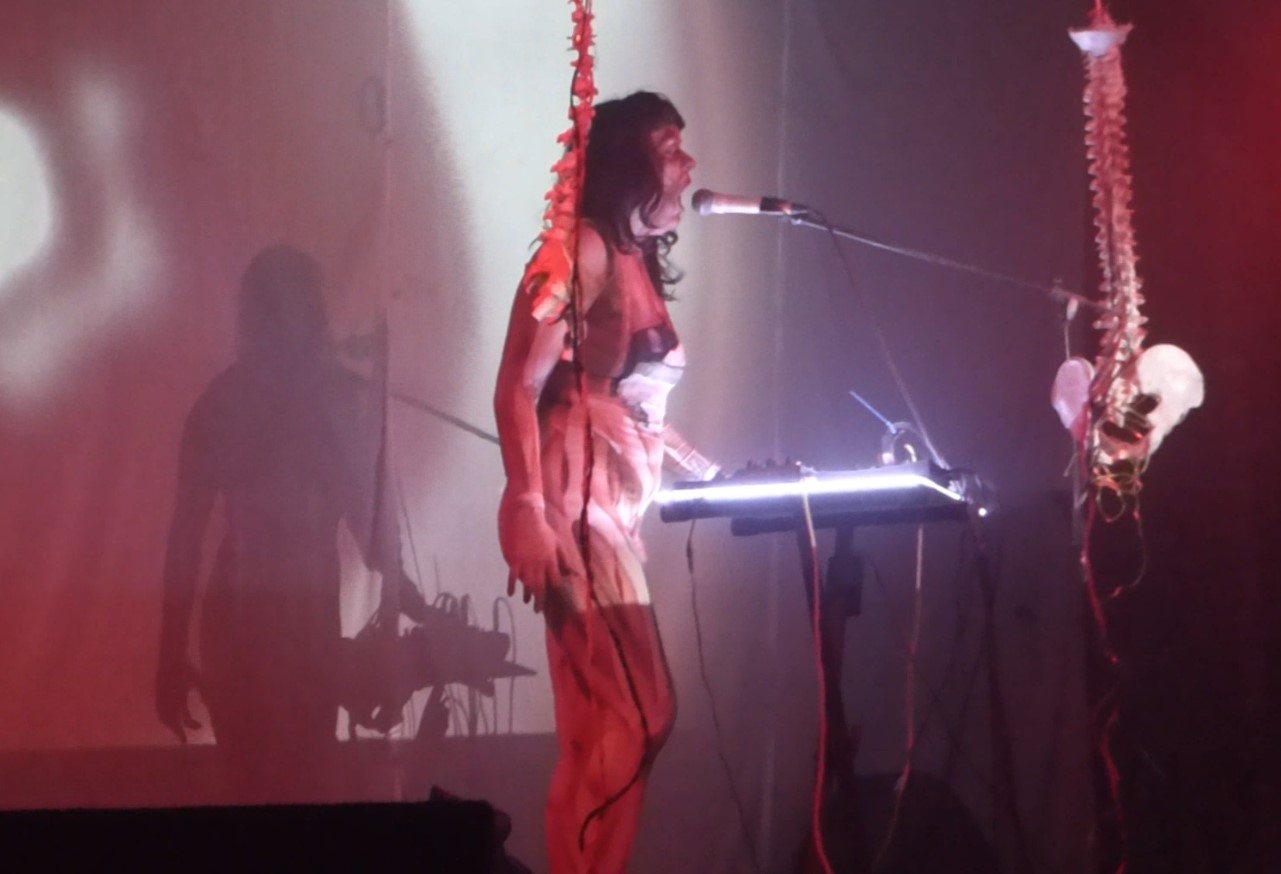
Lone Taxidermist – very very loud and playing two human spines
..a siren goes off... a procession with green faced morris men ...
A’Bear -lovely happy uplifting dancey stuff, this fixed my aching back.

it's all a blurr..but..
An amazing bit of organisation by https://buriedtreasure.bandcamp.com/.
All in all a brilliant weekend!
Friday, 21 June 2019
Friday, 28 December 2018
Saturday, 13 October 2018

Sunday, 17 January 2016
Friday, 7 August 2015
Peter's Stone
Peter's Stone is a mass of limestone which has slipped downhill on a clay layer in Cressbrook Dale. Once called the Gibbet Stone as the bodies of executed criminals were displayed there. In ancient Greek, a rock was called "petros"; the Bible claims that Jesus called his disciple Simon "The Rock" or literally "Peter" in Greek. It is likely that the change from "Gibbet" to "Peter's" Stone is an example of the 19th century effort to erase barbaric or rude place names when guide books and ordnance maps were compiled. In this case the result is to call the site in effect "stone stone" but to link it to the New Testament.
Information from http://www.peakscan.freeuk.com/faq_s___peak_district.htm
Video footage by Nigel Ayers, 1989,
Music from Nocturnal Emissions "Spiritflesh"
Thursday, 1 January 2015
The Healing Sound of Boscawen -Un
Binaural Recording 22 December 2014, the day after Winter Solstice
Sunday, 23 June 2013
The Sacred Sound of the Virgin's Nipple
The uncapped pink granite dolmen atop the Virgin’s Nipple is a sacred place built to hear ourselves and Spirit more clearly as the Earth Goddess’s nipple is stimulated by the rotation of motor traffic.
The circle of stimulation is enhanced by the natural healing radioactivity of the stones. Sound and structure are simply different manifestations of the same universal mathematical constants creating a relationship between the seen and the unseen worlds within and around us. Out of this vibratory field comes an awakening and quickening of spiritual consciousness.
Tuesday, 30 April 2013
May Day

Saturday, 9 February 2013
Contaminated Landscapes
Sunday, 24 July 2011
Leo, the Lion of Goonzion
Leo (The Lion)
Many sightings of the Beast of Bodmin Moor say that it is lion-like, this could be a thought form emanation from the Leo Zodiac outline, which in turn may indicate the boundaries of a Mesolithic (and later Celtic) tribal area.
Leo’s body lies over Goonzion Downs, he is the Lion of Goonzion. Leo also stands on the village of Ley, it could be said that he is a “Ley lion”. Another place name that makes up his outline is Luna. Luna is the Latin name of the Earth's Moon as well as the Roman moon goddess Luna. Leo also stands over the 1412 Pant(h)ers Bridge.
The 'Roaring Shaft' in the complex of mines on Goonzion Down has been said to make a roar like 'a battery of stamps falling regularly with thuds and reverberated through the ground'. These noises may have been natural in origin, but they served to feed the dark images of monstrous beasts and spirits in the minds of those who worked to mine copper, silver and gold.
The sun is in this sign from 24th July to 23rd August. A fire sign.
Key words: kingship, fatherhood, jewels, gold, regal, warmth, fire, sunshine, drama, happiness, command, courage, size, creation, breadth.
Light or planet: the sun.
Body parts: heart, back.
In common with our predecessors Katherine Maltwood (Glastonbury Zodiac), Mary Caine (Glastonbury & Kingston Zodiacs) and Sheila Jeffries (Lizard Zodiac), we begin our exploration with the sign of Leo. The constellation of Leo has been known for more than 5000 years. It was identified in Mesopotamia, when the sun stood in Leo at the time of the summer solstice, its symbol expressing the power of the sun god. Leo is one of the few constellations whose shape clearly corresponds with its name. Alpha Leonis is known as Regula, of 1.4 Magnitude, one of the stars of the Spring Triangle. It is about twice as big as the sun, with 120 times the sun’s luminosity. It is a blue-white star of spectral class B7 with surface temperature of 14,000 K and lies about 78 lights years away from us. Gamma Leonis known as Algieba is one of the most beautiful binary stars. Its components of 2.4 and 3.6 Magnitude are both golden yellow and orbit each other about every 600 years. Their distance is 126 years away from us. R Leonis, a red giant is among the long-period variable stars of the Mira Ceti type. It changes its brightness between 4.4 and 11.3 Magnitude in a course of 310 days. Leo contains many bright galaxies.
According to Greek mythology the first labour of the solar hero Hercules was to kill the Nemian Lion. His enemy, Hera, queen of the heavens, sent it from the moon. A lion is the symbol of St Mark. According to the Bestiary, lions sleep with their eyes open. Lions when hunted would cover their tracks to avoid pursuit. Lions are born dead. Human beings do not enrage a lion so long as they do not harm him. A lion is afraid of a white cock. A lion spares prisoners and those lying on the ground and will eat an ape when ill. Leo is a Lion of Goonzion, whose body lies over Goonzion Downs. Ras Elased Borealis and Ras Elased Australis lie in the parish of Warleggan. The star Zosma lies near the holy well in St Neot.
On 21st July 2006, at 14.36 travelling from Fletchers Bridge towards the sign of Leo, we glimpse a fairy in the bushes on the right hand side of the lane. We stop to investigate further. The fairy wears a lace tutu and pearly earrings and is approximately two feet tall. She has red lips and blue almond shaped eyes. She is smiling and has her arms raised in what would be a ten-past-nine position on a clock face. Her left leg is outstretched and her right leg is bent so that the left foot touches the back of the knee of the right leg. The fairy appears to be made from scrap materials such as old nylon tights and pieces of fabric cut from old curtain material. She is filled like a soft toy and suspended from the bushes by further scraps of material hidden behind her. We continue in a winding, roughly southeast direction, passing Tredale Farm, Pinsla Garden and Nursery, through Pinsla Downs past Gwel An-Nans Farm. At 14.43 we see a wooden signpost, mounted with wrought iron supports on a stone base. The top wooden part of the sign points in four directions, CARDINHAM, WARLEGGAN, and BODMIN are visible, the words on the fourth arm of this sign are slightly obscured but we can make out …DENWELL & CABILLA MANOR. The woodwork of the sign post is painted white, the lettering in black. Rather than having pointed ends, the ends of the signposts are cut with rounded ends, forming semicircular domes rather than points. There is fifth lower post, also cut in this manner, which is set into the wrought iron below the main cross section of the sign post. This post reads: MOUNT and the word is followed by a small painted arrow. We continue down the road through the small village of Mount. In a gap between two dry stone walls at the right hand side of the road, nine stone steps lead up to a small iron gate. Two signs are fixed to the gate. One reads:
NO
UNAUTHORISED
ENTRY
in red lettering. The other larger sign reads
SOUTH WEST WATER
MOUNT
WASTE WATER TREATMENT WORKS
NO UNAUTHORISED ENTRY
A circular filter bed lies in the enclosed space behind the gate. We pass Bofindle Farm on our left and then South Bofindle Farm on our right. We pause at Panters Bridge. On a stone to the right of the bridge there is a green metal sign with a white rounded edge. Some of the white lettering on this sign is missing. It reads:
ANTE S BRIDGE
RI ER BEDALDER
IR A 1415
Grass, stinging nettles and other foliage surround the sign. A rectangular Highways Department sign is fixed to a stone beside the bridge. The sign is painted in white and grey sections. The section with the white background takes up the top one third of the sign and the section with the grey background takes up the bottom two thirds of the sign. In the top section written in black letters are the words WEAK BRIDGE, in the bottom section a smaller white area is enclosed by a red circle. Within the circle are the black letters
3T
mgw
We continue onwards to the village of St Neot. Two old millstones lean against the wall of a building in the street, they are of equal size. There is a quantity of lichen on the millstone on the left. The bottom edges of these stones are flat, so they rest neatly upon the tarmac without rolling away. To the right of the millstones is a white plastic drain spout, draining rainwater from the roof of the property into a gutter beside the millstones. Behind a public bench constructed from concrete sides and wooden seat supports we see a group of three sculpted figures. There are two pieces mounted upon a stone wall and both approximately two feet in height. They are made from scrap materials in a similar style to the fairy we saw near Fletchers Bridge. These figures sit on the wall and are clothed in coloured fabric. They both have heads made from papier-mâché onto which stylised details have been a painted using a palette of primary colours, with shades of brown to represent skin tone. The left sitting figure wears a blue knitted hat striped in shades of blue and purple. Yellow cord-like fabric extrudes from this hat to suggest two pigtails. The left pigtail stands straight upright, while the right pigtail forms a semicircle. This pigtail is attached to the branch of a bush growing above it. The figure wears a pink jumper with a light blue and green patchwork design sewn to its front. It wears white trousers; a green and black scarf is knotted around its neck. Straw extrudes from the wrists and ankles of this figure. The straw is tied at the wrists with orange baler twine. The wide blue eyes of this figure stare straight ahead. The seated figure on the right has been fitted with a wig made from black wool. Its head faces over its left shoulder and its eyes are closed. It wears a dark woollen hat. Navy blue material covers its arms and legs, with two white stripes on each of its arms. Brown fabric covers the body of this figure. A necktie decorated with parallel red, white and black diagonal stripes is tied around its neck. It wears candy-striped leggings, from the ankles of which pieces of straw extrude. Straw also extrudes from the wrists of this figure. Between the legs of this figure, there is a yellow object of a similar size and shape to a lemon. It stands on one of its narrow ends. There is a face painted on this lemon-shaped object. A third figure stands to the left of the two seated figures, by the side of a stone water culvert. This figure is wearing a hooded cape made of brown fabric, over dark coloured undergarments. It has a leather belt buckled around its waist. It is wearing the black headphones of a walkman or personal hi-fi around its neck. Straw, tied with orange baler twine, also extrudes from this figure’s wrists and ankles. This figure has a papier-mâché head and its eyebrows are raised as it looks up at us. Its right arm is holding a freshly cut green stick, which has some leaf buds attached. A fishing line is fastened to the end of the stick and hangs down into the culvert. Three plastic fishes are attached to this line; they have red heads and white bodies. Ferns and mosses grow in the culvert. At 15.12 we notice an arrangement of stones set into the wall on the opposite side of the road. A large, irregular shaped stone is set in a niche formed into the wall, enclosed within an arch consisting of three dressed stones. Above it is a small rectangular carved stone. There are three notches or grooves cut into the rear of the irregular stone.
A sign written in Gothic script marks ST NEOT VILLAGE STORE AND POST OFFICE. There is a red post box marked GR set into the storefront. The window contains a display of craft pottery and sunflowers. The shop front is painted white with a black edge skirting at ground level. A hanging basket with red poppies and other blue flowers hangs beside a red Post Office sign. There is a house nearby with a slate nameplate reading SERENA HOUSE. Across the road many colourful floral baskets hang from the front of the London Inn. The London Inn is the only public house that lies within the sign of Leo, on its front doorway is a brass lion’s head cast in brass. Outside at the front of the inn is low walled enclosure fitted with a wooden bench and two bench seats. The enclosure is paved with irregular shaped pieces of slate. There is a blue ashtray in the centre of the bench. Beside the Inn there is a churchyard which we now enter. A stone carving of a crucifixion stands on a lichen-covered stone memorial. Two rusted iron balls rest on the base of this construction, each ball has a one-inch diameter hole drilled into its centre. A slate set into the side of the church has a skull carved at the top of it. Carved into the slate is a Latin text:
Omne Participes
Nemo praecellit nili que sequendus,
Serior patres ego sum secutas
Me secuturus meditetur unus
Qilque seqentum
Inside the church porch there is a notice board, fixed to this is a plastic-laminated sign headed GRYLLS SUNDIAL. There is a diagram of the sundial and more explanatory text. Pinned to the church door is a smaller sign, also laminated in plastic, it reads:
WRITTEN PERMISSION FROM THE
VICAR MUST BE OBTAINED BEFORE
ANY REPRODUCTION OR
PUBLICATION OF PHOTOGRAPHS
We wonder what this ecclesiastical authority wants to hide as we enter the church. We become aware of a plenitude of leonine imagery within. In a stained glass window, a saint holds a small winged and haloed lion. In another window a round-eared lion is shown on the deck of Noah’s Ark. In two other stained glass panels showing the life of St Neot, a golden lion’s face features on the side of fountains, spewing forth milky water. In another stained glass, Jesus and his disciples sit around a round table, of the sort more often favoured by King Arthur. At 15.36 we notice a sundial attached to the outside of the church. It is dated 1682. According to this sundial the time is now 2pm.
see alsohttp://www.nigelayers.com/zodiac/leo.html
Friday, 24 June 2011
Bodmin Moor Zodiac: Cancer the Cabilla Crab
The sun is in this sign from 23 rd June to 23 rd July. A water sign.
Key words: memory, home, antiquity, food, motherhood, tides.
Light or planet: the moon.
Body parts: breasts, stomach.
Cancer is the least visible sign of the zodiac. In Greek mythology, the goddess Hecate sent the crab to kill Heracles. Hecate’s equivalent, known as Trivia in Roman mythology, was the goddess of witchcraft, the three-way crossroads, and the harvest moon. She was an underworld Titan-goddess who assisted Jove in the Titanomachy and was therefore able to keep her powers. She was a friend of Ceres and helped her find Ceres’ daughter Prosepina. As a part of her role as an underworld goddess, she was known as the Queen of Ghosts. Images of Hecate, as a liminal goddess were placed at borders as a ward against danger. The liminal state is characterised by ambiguity, openness, and indeterminacy. One’s sense of identity dissolves to some extent, bringing about disorientation. Liminality is a period of transition, during which normal limits to thought, self-understanding, and behaviour are relaxed, opening the way to something new. People, places, or things may not complete a transition, or a transition between two states may not be fully possible. Those who remain in a state between two other states may become permanently liminal. It became common to place statues of the Hecate at the gates of cities, and eventually domestic doorways. Over time, the association of keeping out evil spirits led to the belief that, if offended, Hecate would also let in evil spirits. Thus invocations to Hecate arose as the governess of the borders between the normal world and the spirit world. The hero Heracles stepped on the crab and killed it, but the goddess rewarded the boldness and devotion of the crab by placing it among the constellations. Two or three millennia ago the sun stood in Cancer on the summer solstice, after which it returned south. Cancer is an example of star motion in both directions. Alpha Cancri known as Acubens of 4.3 Magnitude is a double star, the smaller star is 1,000 times fainter than the larger star and is of 11.8 Magnitude. They are about 174 light years away. The triple star Zeta Canceri is about 83 light years away from us. Its components A and B revolve over a period of 60 years, component C revolves around them in about 1200 years. Cancer also contains the stars Asellus Borealis and Asellus Australis which represent two donkeys, the northern and the southern.
In Spanish cabilla means treenail. A treenail (pronounced “trunnel” rhyming with “tunnel”) is a cylindrical pin of oak, or other hardwood, used to secure the planks of a wooden ship to the ribs. They were used instead of metal nails or bolts because they did not rust or loosen or because metal was not available. Also in Spanish, the word cabilla describes the masculine sexual organ. In Hebrew Cabbala, means reception, Standard Hebrew Qabbala, Tiberian Hebrew Qabbālāh; (also written variously as Cabala, Cabalah, Kabala, Kabalah, Kabbala, Kabbalah, Qabala, Qabalah) is an interpretation, exegesis, or hermeneutic key of the Torah, or the religious mystical system of. The Cabilla crab is decapod having eyes on short stalks and a broad flattened carapace with a small abdomen folded under the thorax and pincers, simultaneously it represents a crab apple on the Tree of Life. The Tree of Life is an important notion within the Kabbalah of Judaism. It was later adopted by some Christians, Hermeticists, and even some pagans and is also found in evolutionary theory. A page from Charles Darwin’s notebooks around July 1837 shows the first-known sketch by Charles Darwin of an evolutionary Tree of Life. The origin of the symbol or glyph of Cancer has been given diverse interpretations. Some sources describe it as a representation of the breasts, an area of the anatomy ruled by Cancer and which is also indicative of the inherent nurturing nature of this Sign. Other sources liken the glyph to a pair of crab claws, intertwined in such a manner as to represent the dual nature of the Cancer individual. In this latter interpretation, it is similar to the Asian symbol of the Yin and the Yang. In Vedic Astrology, this glyph signifies the Womb of Time, in which all manifestation takes place and is symbolic of the caring qualities associated with motherhood, as well as spiritual creativity.
In Egypt, Cancer was represented by two turtles known as the Stars of the Water and occasionally as an obscure aquatic creature known as Allul. Perhaps more than any other zodiac sign, Cancer is symbolic of the passive, receptive but profoundly powerful and encompassing female force in nature, the all-nourishing or all-devouring mother. Judaism is a monotheistic religion, strongly connected to a patriarchal God, Yahweh. However, a goddess was associated with Judaism from its conception, and has continued to play an important part, in various forms, to the present. The goddess is best known as Shekhina, a Talmudic term describing the manifestation of God’s presence on earth. While the name Shekhina has been erased from the Bible, she is nevertheless bound to extremely old traditions, and closely relates to ancient goddesses. Particularly significant is the Canaanite goddess Ashera or Ash Ra who, at the beginning of the Israelites’ settlement in the land of Canaan, was often referred to as Yahweh’s consort. In Kabbalistic astrology Cancer is known as Tammuz named after the Babylonian corn god. It is one of the three negative months of the year: Tevet, Tammuz and Av. In Tammuz the walls around Jerusalem were penetrated. The Kabbalah teaches that the course of history transpires from the cyclical energy processes of the year rather than because of physical events. Therefore, by looking at the time at which each moment in history occurs, we can better understand why it happened. Each planet controls two signs, except for the sun, which controls only Leo (Av) and the moon, which controls only Cancer (Tammuz). Because the sun and the moon control one sign each, an unbalanced situation is created in each of these months. This imbalance causes the crab, the symbol for the month of Tammuz, to walk sideways rather than forward and backward. This could explain the many deviations that have occurred during our ritual walks in the sign of the crab.
Cancer is the only astrological sign named after a disease. Nearly all cancers are caused by abnormalities in the genetic material of the transformed cells. These abnormalities may be due to the effects of carcinogens, such as tobacco smoke, chemicals, infectious agents, or radiation. Many modern astrologers consider it significant that the first atomic bomb was detonated when Saturn reached the longitude of 20 degrees Cancer. Cancer-promoting genetic abnormalities may also be randomly acquired through errors in DNA replication, or are inherited, and thus present in all cells from birth. Complex interactions between carcinogens and the host genome may explain why only some develop cancer after exposure to a known carcinogen. New aspects of the genetics of cancer pathogenesis, such as DNA methylation, and micro-RNAs are increasingly being recognised as important. Under the tropical zodiac, Cancer is occupied by the sun from June 21 st to July 22 nd and under the sidereal zodiac, it is currently from July 21 st to August 9 th. The sign opposite to Cancer is Capricorn.
Piecing a ritual walk together from the remnants of the Cabilla crab, through gorse bushes and stone tracks, is like retrieving a false memory, the visual evidence for truths we prefer to forget. The crab defines the limits of the imagination of Mesolithic Cornwall, to try and get a sense of the original shape by tapping its ruins, following our designated route, is futile. We are contradicted, misinformed, fenced out for every inch of the journey. But the perversity of that desire, to pick up on the energy field, is a strong as ever.
Friday, 29 April 2011
Thursday, 3 March 2011
Tuesday, 1 February 2011
The Virgin's Nipple
(in case you missed it)

The Highways Agency is keeping very quiet about an alternative name for the big roundabout on the A38 Dobwalls bypass.
This may well be because the rather rude nickname, refers to part of an innocent woman's upper body.
The Virgin's Nipple originated from a book written by local author, Nigel Ayers, about Bodmin Zodiac signs.
Nigel created these signs on the moor and at the bottom of the circle is Virgo, the Virgin of Dobwall's.
The Highway's Agency then came along and built the bypass and the roundabout near Dobwalls.
Nigel says there is only one name the roundabout can really be given.
 The rather unglamorous Twelvewoods roundabout |
"What I had found was they had put the Twelvewoods roundabout right in the position of the right nipple of this goddess which I had sketched out on the landscape."
The Bodmin Moor Zodiac is the largest piece of land art ever constructed in the UK.
"There are lots of places around which have got some quite rude names, I mean look at Brown Willy, and these places have managed to stay with these names, so I don't know why they can't keep The Virgin's Nipple if it's going to catch on."
BBC Radio Cornwall's Michael Taylor reported from the roundabout on the A38 at Dobwalls.
The Highways Agency were given plenty of opportunity to comment, but BBC Radio Cornwall has heard nothing from them.
There now appears to be some confusion about which name the roundabout should take.
Up in Bristol it was a normal day in the office of Trafficlink which provides traffic information to the BBC.
That was until the police rang in to report an accident on the Twelvewoods roundabout on the A38 at Dobwalls.
 Nigel Ayer's Bodmin Moor Terrestrial Zodiac |
Dan O'Hare from Trafficlink, needing to pinpoint the exact location of the accident, went onto the internet to do some research.
"I went onto the internet to do a quick search to find some more local information and the Twelvewoods roundabout came up with The Virgin's Nipple before it".
The use of the name Virgin's Nipple has also been used on the Highways Agency's very own radio station.
Local Councillor Peter Scott thinks the whole thing is hilarious: "As it stands I think it's quite appropriate, virgin's nipple, untouched by man, that's quite appropriate for the roundabout, which is quite baron in itself and never looks as though anyone has ever done anything to it."
Since the roundabout was constructed the Highways Agency has resisted calls from people in Dobwalls to put something on it to brighten it up a bit.
Suggestions included a large chunk of Cornish granite and a giant pasty but the agency said a very firm "no" because it doesn't want anything on here which might distract drivers.
http://news.bbc.co.uk/local/cornwall/hi/people_and_places/newsid_9377000/9377844.stm